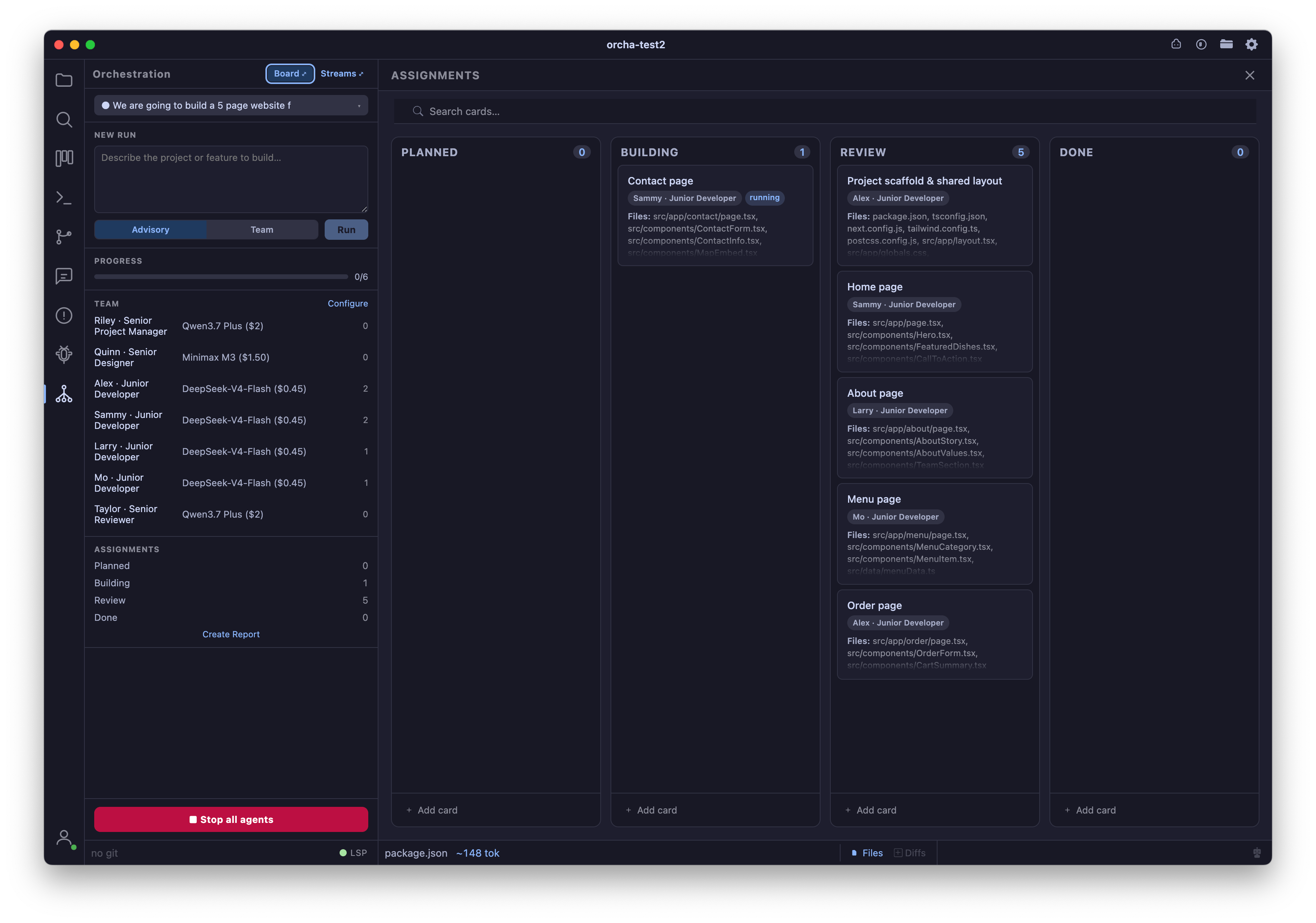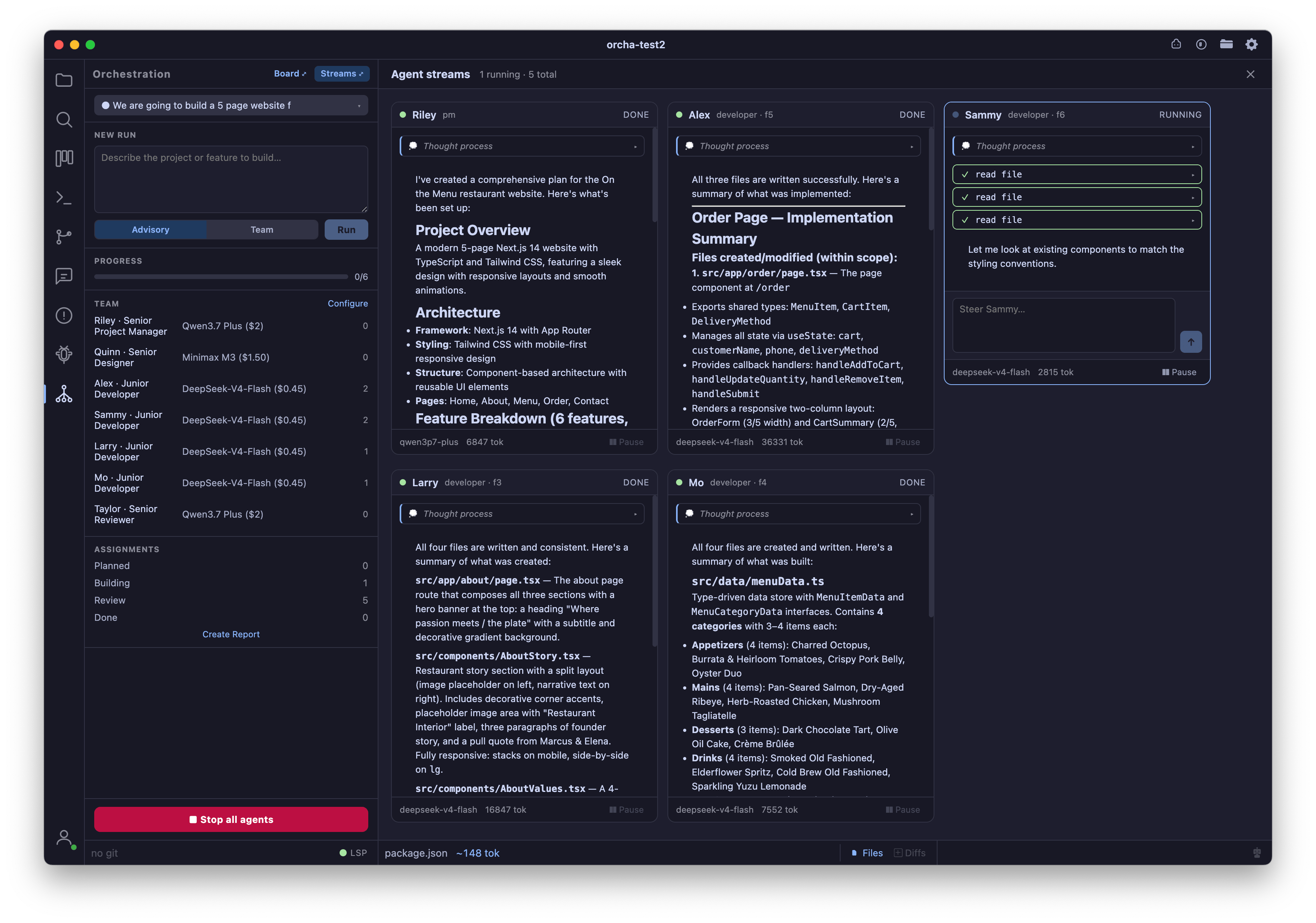
- New Run box describe a goal, pick Advisory or Team mode, hit Run; the pipeline chains Plan → Build → Review automatically in one run
- Roles & tiers configurable team in Settings → Orchestrator: a role (Project Manager, Designer, Developer, Reviewer, or any custom role you add) has its own system prompt; each role has agents (a name + seniority tier + model), so one role can span a Senior on a strong model and Juniors on cheap/fast ones
- Plan stage a PM agent decomposes the goal into file-disjoint features (each feature owns a set of files no other feature touches) plus shared naming/structure conventions, written to
plan.json - Build stage, real parallelism features are grouped into dependency waves; every feature in a wave is file-disjoint by construction, so the whole wave builds concurrently, each feature assigned a different agent from its role’s roster (round-robin) where more than one is configured, capped by Max parallel agents (Settings → Orchestrator)
- Review stage a read-only reviewer agent cross-checks the built tree against the plan and writes a verdict (pass / changes-needed) plus a list of issues to
review.json; Advisory mode always stops here and hands you the report, no send-back loop yet - Manual “Run Review” re-run the review stage on the active run any time (safe mid-run or after a manual code tweak) without starting a whole new run
- Live monitor a stream tile per active agent (reasoning, tool calls, streamed text) in a resizable, wrapping grid; pause/resume any agent, or send it a steering message mid-run
- Assignments board a Kanban view (Planned → Building → Review → Done) of every feature, reusing the same board component as the project Kanban; open any card to see its assigned agent and status
- Run report “Create Report” builds a markdown fan-in report for the active run (plan, build results, review verdict/issues, and real per-agent token costs pulled from the token log) and writes it to that run’s own folder, never touches your project files
- Multiple runs each run is a self-contained folder (
.coder/orchestration/runs/<runId>/); a run switcher lets a mono-repo track several runs (e.g. website / api / app) independently - Quiet by design orchestrated agents write files silently (no auto-opened tabs/diffs, no editor streaming) so a multi-agent build never floods your open tabs; the interactive chat agent is unaffected and keeps its normal streaming behavior
- Toggle
Cmd+Shift+Oopens and closes the Orchestrator panel
Shotcut Key Commands